Fast UK dispatch · Third-party tested · Lot-matched certificates
Healing & Recovery
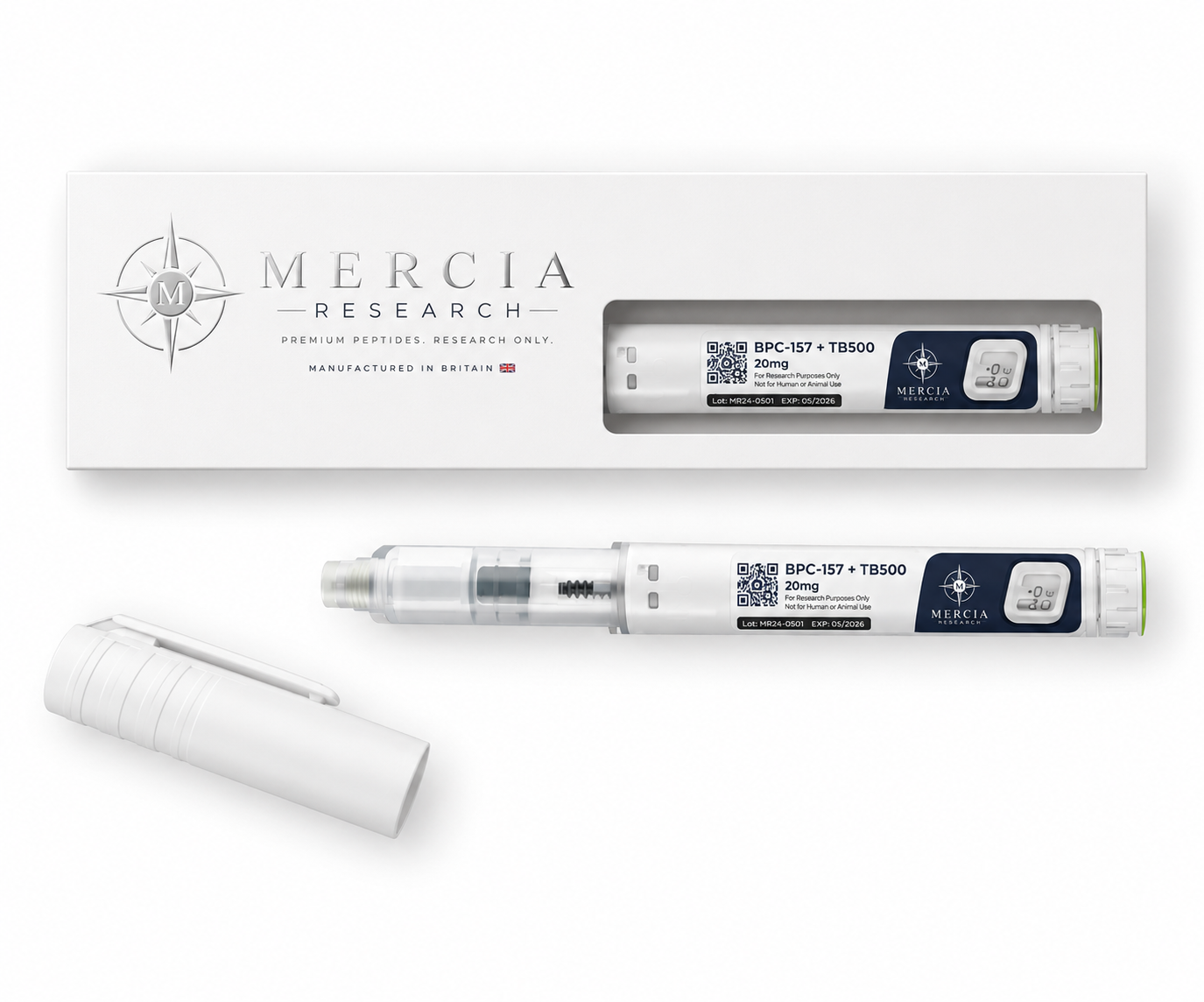
BPC-157 / TB-500 20mg
- Type:
- Paired repair-pathway research blend.
- Form:
- Ready-to-use liquid solution in a 20mg research cartridge.
- Composition:
- 10mg BPC-157, 10mg TB-500.
- Application:
- Combined repair-pathway studies
BPC-157
10MG
TB-500
10MG
20mg · 1:1 · Ready to use
£5.85 per mg · 20mg total
£117.00
Choose your pack
Lot-matched 3rd party CoA with every batch
Qty
≥99.0%
HPLC purity, verified per lot
MS
Mass-spec confirmed identity
LAL
Endotoxin tested to established limits
UK
Synthesised and tested in Britain
What's in the cartridge
Component 01
BPC-157
10MG
Studied primarily for its angiogenic and tissue-repair properties, with interactions involving VEGF signalling and mucosal integrity.
Component 02
TB-500
10MG
A synthetic fragment of Thymosin Beta-4. Operates principally through actin sequestration and cellular migration pathways.
Why they're paired
Preclinical investigations using combined BPC-157 and TB-500 have focused on tendon-ligament-vasculature crosstalk in musculoskeletal injury models, synergistic effects on cellular migration and new vessel formation, and the interaction between actin-binding and growth factor signalling pathways.
Specifications
Format
Liquid peptide solution, 20mg
Molecular formula
BPC-157 + TB-500 (1:1)
Molecular weight
Blend
Purity
≥99.0%
Abbreviation
BPC+TB
Vials vs Pens
11 Steps. Or one.
A vial arrives as powder: you mix it, measure it, and draw every dose by hand. The Mercia Pen arrives ready.
Traditional Vial
Mercia Pen
11 steps
mixing, measuring, drawing
1 click
dial the dose, press
~12 minutes
plus a 5 minute wait mid-way
12 seconds
ready when you are
Hand-measured
syringe markings, eyeballed
Mechanical click
the same dose, every time
Opened repeatedly
every needle re-entry is a risk
Factory-sealed
never opened, never mixed
Syringes + water
plus wipes and a sharps bin
Nothing else
everything is in the pen
Handling and storage
Store
Store immediately at 2–8°C upon delivery. Do not freeze.
Shipping
Shipped in validated temperature-controlled packaging to maintain product stability during transit.
Avoid Freezing
Do not freeze, as freezing may compromise product quality.
Temperature Tolerance
Stabilised below 25°C for delivery. Should not be exposed to higher temperatures.
3rd Party Tested
Independently tested for heavy metals, residual solvents and endotoxins to established limits.
Full Traceability
Batch-level traceability from production to delivery.
Certificate of Analysis
Lot-matched 3rd party CoA with every batch. Available on our website.
Shelf Life
12 months from manufacture when stored at 2–8°C.
What customers say
Research overview
The BPC-157 / TB-500 blend (also written BPC157 TB500) combines two of the most extensively studied repair-pathway peptides in a single pre-mixed liquid peptide solution in a 3ml research cartridge. Manufactured in the UK and supplied ready to use, with no reconstitution step, this BPC-157 TB-500 blend has become a frequent starting point for UK researchers investigating combined angiogenic, cytoprotective and cytoskeletal repair pathways.
BPC-157 — Angiogenic and Cytoprotective Mechanisms
BPC-157 is a synthetic pentadecapeptide, a partial sequence of a gastric protective protein found in human gastric juice, first isolated in the 1990s. Its most extensively documented research pathway involves upregulation of vascular endothelial growth factor (VEGF) and its receptor VEGFR2, promoting new capillary formation into damaged tissue. Studies have also examined its interaction with the nitric oxide system, including upregulation of endothelial nitric oxide synthase (eNOS), contributing to vasodilation and endothelial protection alongside its angiogenic effects.
Beyond angiogenesis, preclinical research has explored BPC-157's involvement in FAK-paxillin focal adhesion signalling and Egr-1 transcription factor activity, both relevant to endothelial cell migration and early tissue scaffolding after injury. A separate and consistently replicated body of research has examined possible interactions with growth hormone receptor expression, with some studies suggesting downstream amplification of IGF-1 signalling in target tissues. Reflecting its origin in gastric juice protein, BPC-157 has also been studied extensively in gastrointestinal models, including mucosal barrier integrity and gut lining research.
TB-500 — Actin Sequestration and Cell Migration
TB-500 is a synthetic peptide corresponding to the actin-binding domain of Thymosin Beta-4, a naturally occurring 43-amino-acid protein. Its core, well-characterised mechanism is the sequestration of monomeric G-actin via the LKKTETQ binding motif, holding a reversible pool of unpolymerised actin that cells can rapidly mobilise into filamentous F-actin at the leading edge when migration signals are received. This underpins the formation of lamellipodia and filopodia, the structural extensions cells use to move directionally into a wound site.
Beyond its structural role in actin dynamics, TB-500 research has examined activation of the integrin-linked kinase (ILK) and downstream Akt signalling pathway, associated with cell survival and migration in tissue-repair models. Separately, thymosin beta-4-related research has documented VEGF induction via a HIF-1α-dependent pathway, giving TB-500 a secondary angiogenic research relevance alongside its primary actin-sequestering mechanism.
Combined Repair-Pathway Research
Preclinical investigations using combined BPC-157 and TB-500 have focused on tendon-ligament-vasculature crosstalk in musculoskeletal injury models, examining whether BPC-157's angiogenic and growth-factor signalling combines with TB-500's actin-driven cell migration to produce effects beyond either peptide studied alone. Research interest in this pairing centres on the potential overlap between new vessel formation and the cellular motility required to populate a healing site, alongside the shared downstream involvement of VEGF signalling from both compounds via distinct upstream mechanisms.
Research Format and Quality Assurance
Pre-mixed as a combination in a 3ml research cartridge, this format is designed for UK researchers who wish to study both compounds simultaneously without a separate reconstitution step for each. Each batch is independently HPLC-tested for purity and mass-spectrometry confirmed for the identity of both peptides, with a lot-matched Certificate of Analysis issued for every order.
For laboratory research use only. Not intended for human or animal consumption.
Frequently asked questions
Is a Certificate of Analysis included?+
Yes. Every order ships with a third-party CoA matched to the lot number printed on your cartridge. A sample CoA is available on the site.
How is purity verified?+
Each batch is HPLC-tested for purity and mass-spec confirmed for identity, then tested for heavy metals, residual solvents and endotoxins.
Does the solution need reconstituting?+
No. The cartridge is supplied as a ready-to-use liquid solution in 3ml bacteriostatic water.
How is it shipped and stored?+
Validated temperature-controlled packaging, UK next-day dispatch. Store at 2–8°C on arrival, do not freeze, 12-month shelf life.
Who is this supplied to?+
Qualified personnel for in vitro laboratory research and analytical work only. Not for human or animal consumption.
Related compounds
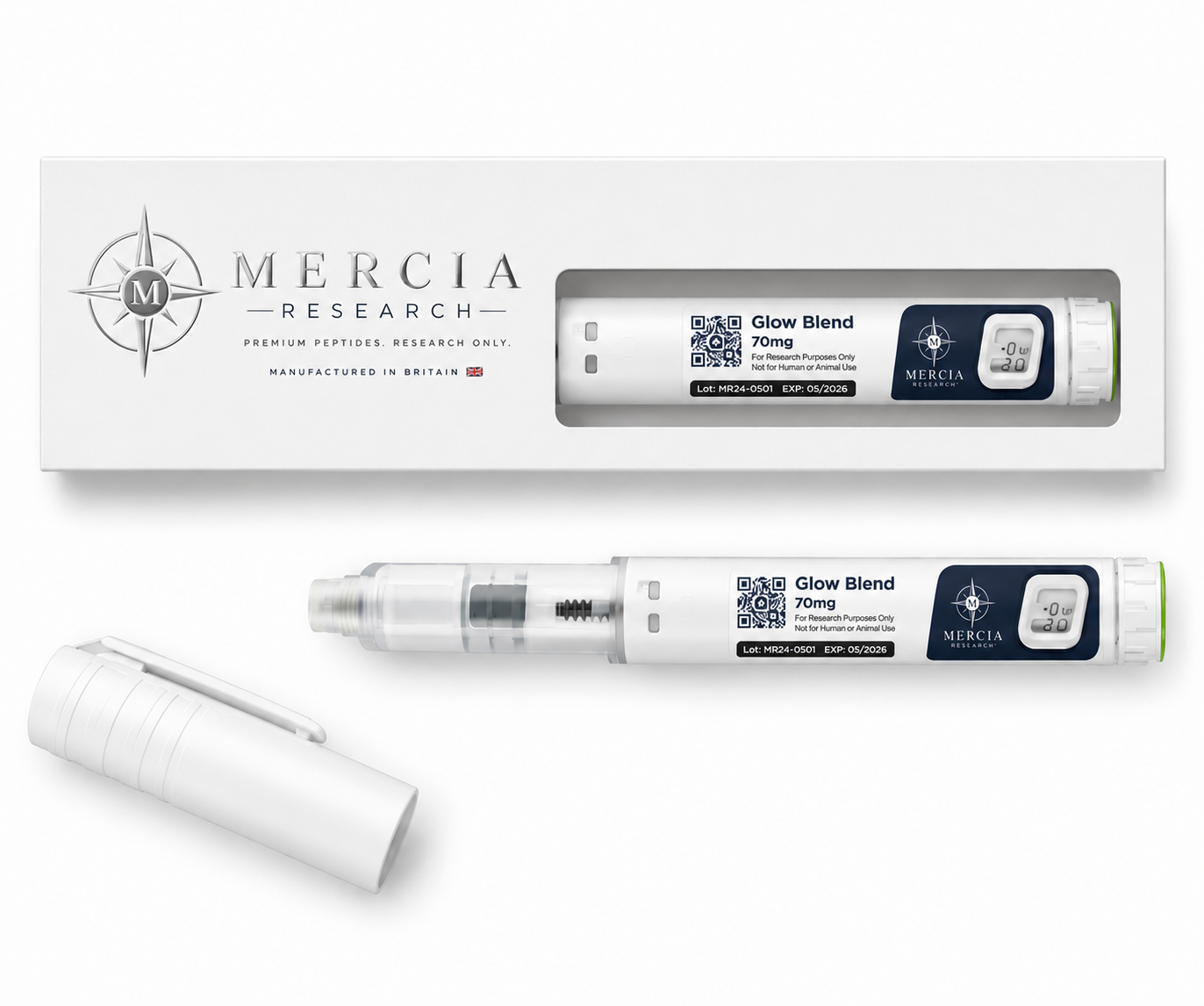
- GLOW Blend 70mg (50mg/10mg/10mg) — Also contains BPC-157 and TB-500, alongside GHK-Cu