Fast UK dispatch · Third-party tested · Lot-matched certificates
Neuro & Cognitive
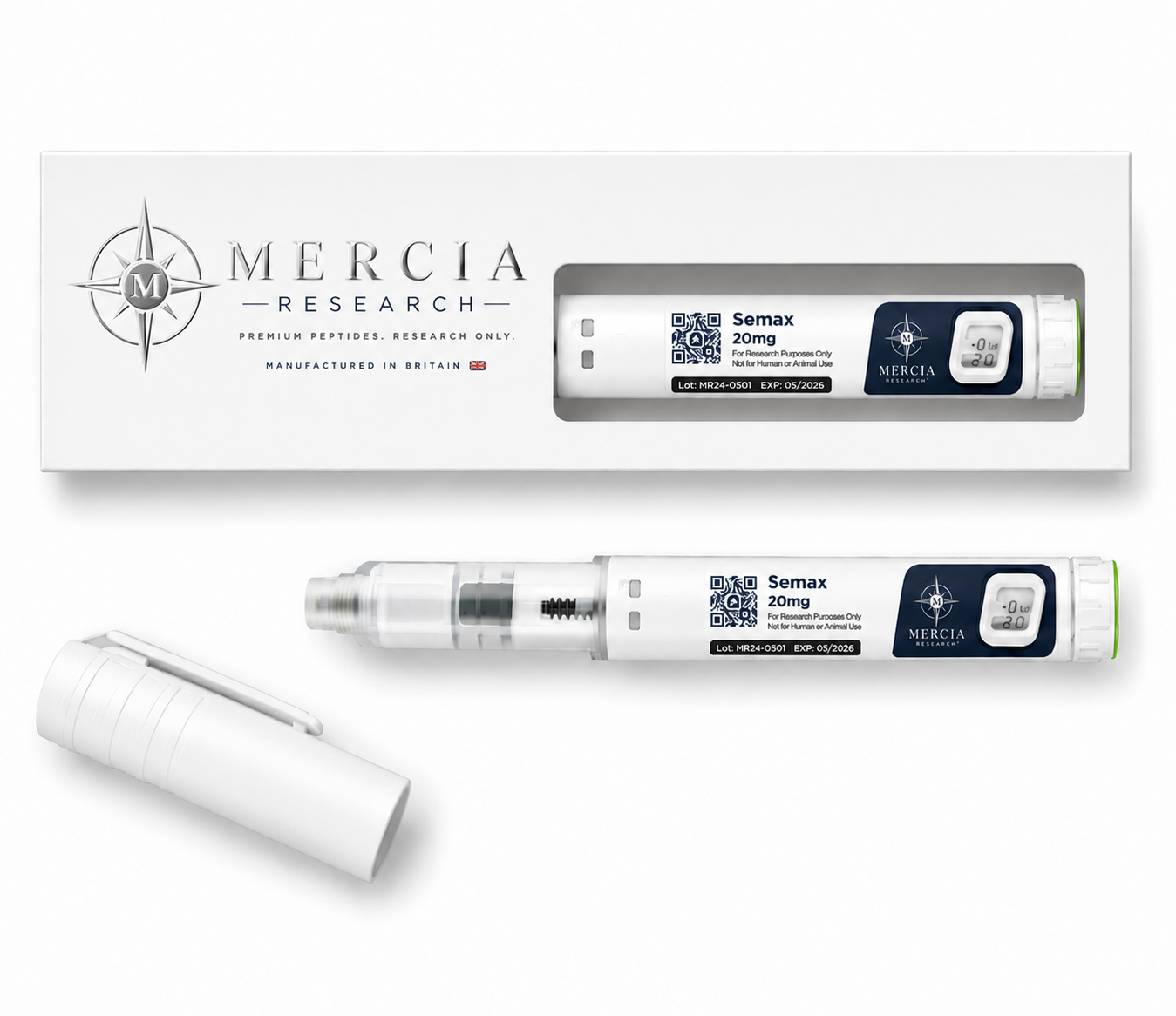
Semax 20mg
- Type:
- ACTH(4-10) analogue.
- Form:
- Ready-to-use liquid solution in a 20mg research cartridge.
- Application:
- BDNF / NGF expression
Semax
20MG
20mg · Ready to use
£9.95 per mg · 20mg total
£199.00
Choose your pack
Lot-matched 3rd party CoA with every batch
Qty
99.08%
HPLC purity, verified per lot
MS
Mass-spec confirmed identity
LAL
Endotoxin tested to established limits
UK
Synthesised and tested in Britain
What's in the cartridge
Supplied as a liquid peptide solution in a 3ml research cartridge. Contains Semax (20mg). A synthetic ACTH(4-10) analogue developed in Russia, studied in BDNF/NGF expression, neuroprotection, and ischaemic recovery models.
Specifications
Format
Liquid peptide solution, 20mg
Molecular formula
C₃₇H₅₁N₉O₁₀S
Molecular weight
813.93 g/mol
Purity
99.08%
Abbreviation
SMX
Vials vs Pens
11 Steps. Or one.
A vial arrives as powder: you mix it, measure it, and draw every dose by hand. The Mercia Pen arrives ready.
Traditional Vial
Mercia Pen
11 steps
mixing, measuring, drawing
1 click
dial the dose, press
~12 minutes
plus a 5 minute wait mid-way
12 seconds
ready when you are
Hand-measured
syringe markings, eyeballed
Mechanical click
the same dose, every time
Opened repeatedly
every needle re-entry is a risk
Factory-sealed
never opened, never mixed
Syringes + water
plus wipes and a sharps bin
Nothing else
everything is in the pen
Handling and storage
Store
Store immediately at 2–8°C upon delivery. Do not freeze.
Shipping
Shipped in validated temperature-controlled packaging to maintain product stability during transit.
Avoid Freezing
Do not freeze, as freezing may compromise product quality.
Temperature Tolerance
Stabilised below 25°C for delivery. Should not be exposed to higher temperatures.
3rd Party Tested
Independently tested for heavy metals, residual solvents and endotoxins to established limits.
Full Traceability
Batch-level traceability from production to delivery.
Certificate of Analysis
Lot-matched 3rd party CoA with every batch. Available on our website.
Shelf Life
12 months from manufacture when stored at 2–8°C.
What customers say
Research overview
Semax is a synthetic heptapeptide analogue of the ACTH(4-10) fragment of adrenocorticotropic hormone, sometimes written Semax peptide. Developed at the Institute of Molecular Genetics in Moscow and supplied here as a UK-manufactured liquid peptide solution for researchers looking to buy Semax in the UK, it has been the subject of extensive neurological research, particularly in the areas of neuroprotection and cognitive function.
BDNF and NGF Expression
One of the most studied aspects of Semax is its influence on neurotrophic factor expression. Research has examined its effects on brain-derived neurotrophic factor (BDNF) upregulation in hippocampal and cortical tissue, nerve growth factor (NGF) expression in preclinical models, and the downstream effects of neurotrophic signalling on neuronal survival and plasticity.
Neuroprotection Research
Semax has attracted interest in neuroprotective research contexts. Studies have investigated its protective effects in models of oxidative stress-induced neural damage, interactions with anti-apoptotic signalling cascades in neural tissue, and its effects on microglial activation and neuroinflammatory mediators.
Ischaemic Recovery Models
A significant body of preclinical research has examined Semax in cerebral ischaemia models. Research has explored its effects on infarct volume following experimental ischaemic events, neurovascular unit preservation in stroke models, and recovery of neurological function in preclinical settings.
Dopaminergic and Serotonergic Research
Semax has also been studied in relation to monoamine neurotransmitter systems, including dopamine receptor sensitivity modulation and serotonin turnover in brain regions associated with mood and cognition.
For laboratory research use only. Not intended for human or animal consumption.
Frequently asked questions
Is a Certificate of Analysis included?+
Yes. Every order ships with a third-party CoA matched to the lot number printed on your cartridge. A sample CoA is available on the site.
How is purity verified?+
Each batch is HPLC-tested for purity and mass-spec confirmed for identity, then tested for heavy metals, residual solvents and endotoxins.
Does the solution need reconstituting?+
No. The cartridge is supplied as a ready-to-use liquid solution in 3ml bacteriostatic water.
How is it shipped and stored?+
Validated temperature-controlled packaging, UK next-day dispatch. Store at 2–8°C on arrival, do not freeze, 12-month shelf life.
Who is this supplied to?+
Qualified personnel for in vitro laboratory research and analytical work only. Not for human or animal consumption.